
I see many buyers lose warehouse space because standard bulk bags bulge after filling. The bag looks simple, but the hidden cost becomes serious.
I define a baffle FIBC bag as a bulk bag with internal fabric panels that help the filled bag keep a more square shape. I use it when better stacking, pallet fit, and container space use matter more than the lowest unit price.

I have discussed baffle bags with many buyers who first asked for a “square bulk bag.” I usually tell them that the real question is not only what the bag is. The better question is whether their material, filling line, pallet size, and transport plan really need this structure. That small change in thinking can avoid wrong samples, wasted testing time, and a bag that looks good on paper but does not solve the real problem.
How does a baffle FIBC bag keep a square shape?
I see standard FIBC bags expand outward when filled. This can create rounded sides, unstable stacks, and poor pallet use in daily warehouse work.1
A baffle FIBC bag uses inner fabric panels to control side expansion after filling.2 I use these panels to reduce bulging, improve the bag shape, and help the bag sit better on pallets or inside containers.
What I look at inside the bag
I do not treat a baffle FIBC as only a normal bulk bag with a square look. I first look at the inner structure. The baffles are usually fabric panels sewn inside the four corners or along the side areas. [These panels allow material to flow through them, but they also limit how far the side fabric can expand.] 3 This is why the filled bag can keep a more block-like shape than a normal U-panel or circular bulk bag.
In my factory work, I have seen that the small details of the baffle panel matter. The opening size, sewing line, fabric strength, and position all affect filling and discharge. If the material is too sticky or has poor flow, a wrong baffle design can slow filling or leave material inside.
| Bag part | What I check | Why it matters |
|---|---|---|
| Inner baffle panels | Fabric type, size, and openings | I need material flow and shape control at the same time |
| Outer body fabric | GSM, coating, and UV needs | I need the main body to match the load and storage condition |
| Sewing lines | Stitch type and stress points | I need the panels to stay stable during filling and handling |
| Filling top | Spout, duffle, or open top | I need it to match the customer’s filling system |
| Discharge bottom | Spout, flat bottom, or special design | I need smooth emptying and safe handling |
Why I do not call it only a square bag
I avoid calling it only a square bag because that description is too simple. A baffle FIBC still changes shape under load. It is not a rigid box. The final shape depends on product density, filling height, vibration, lifting, and storage time.4 I explain this to buyers early because it helps them set a realistic target. A good baffle bag improves shape control. It does not create a perfect box in every case.
When do I recommend a baffle FIBC bag instead of a standard FIBC?
I do not recommend baffle bags for every buyer. A higher unit price makes no sense if the standard bag already works well.
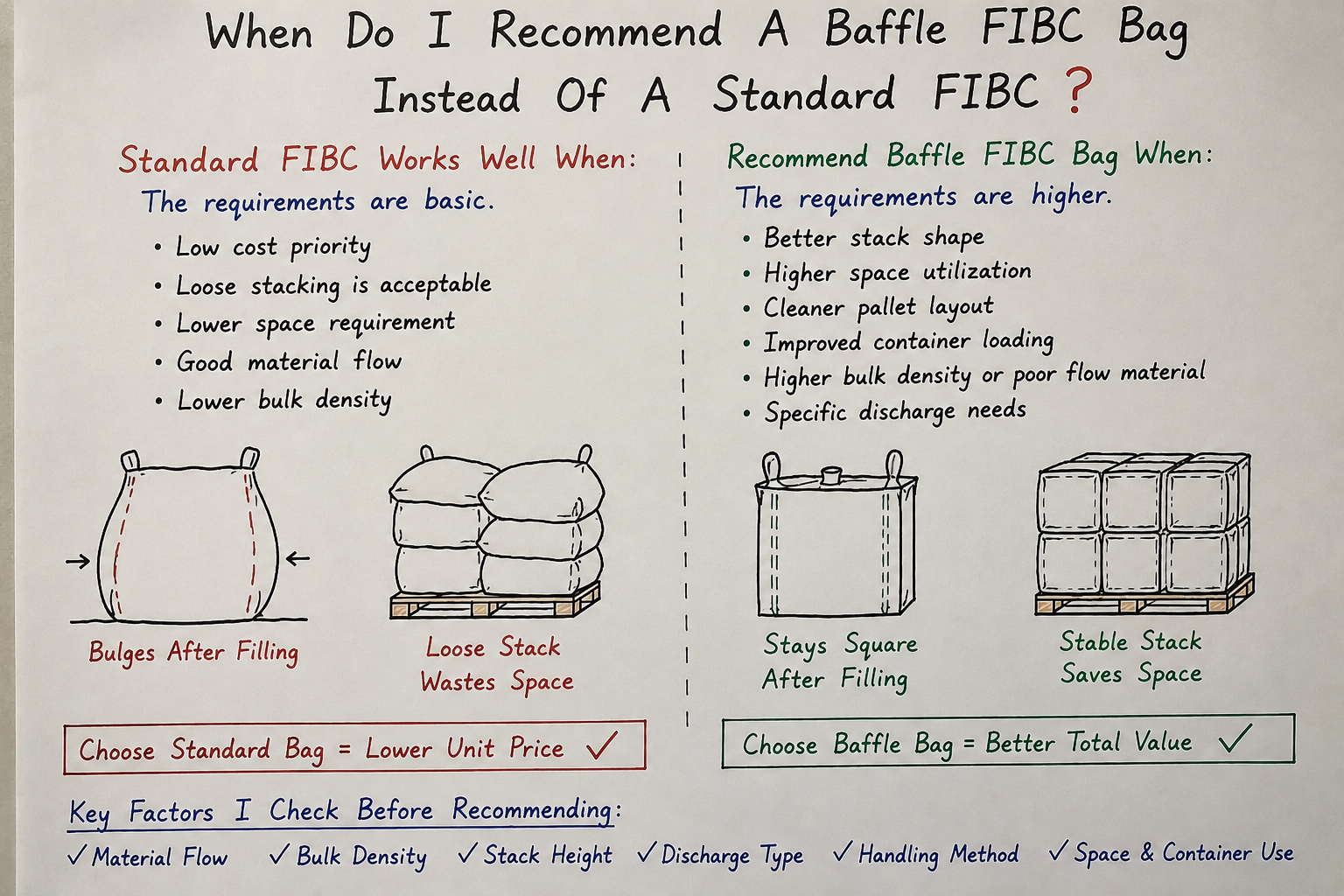
I recommend a baffle FIBC bag when the buyer needs better stack shape, higher space use, cleaner pallet layout, or improved container loading. I also check material flow, bulk density, and discharge needs before I suggest it.
The decision starts with the material
I always ask about the material before I talk about price. Some products behave well in baffle bags. Some products do not. Granules, pellets, rice, seeds, resin, and some free-flowing powders often work well.5 Sticky powder, damp product, or product with poor flow needs more careful design. If the product bridges around the baffle panels, the buyer may face slow discharge or product left inside the bag.6
I also ask about bulk density. A light product may fill a larger volume but place less load on the bag. A dense mineral or chemical may reach the target weight before the bag reaches full volume.7 This changes the bag size, safety factor, fabric choice, and the value of using baffles.
| Buyer question | My reason for asking |
|---|---|
| What material will you pack? | I need to understand flow and surface behavior |
| What is the bulk density? | I need to match volume and target weight |
| Is the product powder, granule, flake, or lump? | I need to judge filling and discharge risk |
| Is the product dry or moist? | I need to check flow and coating needs |
| Is the product food, chemical, mineral, or waste? | I need to check cleanliness, safety, and certification needs |
The decision also depends on the handling plan
I do not look at the bag as a single product. I look at the full handling process. If the buyer fills the bag by machine, stores it on pallets, stacks it in a warehouse, and ships it in containers, the baffle structure may create real value. If the buyer only fills the bag and uses it once in a short local movement, the added cost may not be justified.
I once worked with a buyer who wanted baffle bags because their customer liked the appearance. After we discussed their loading plan, I found that their current problem was not only bulging. Their pallet size did not match their bag footprint. In that case, changing the bag size and baffle structure together made more sense than only adding baffles to the old design.
What details should I confirm before I quote a baffle FIBC bag?
I cannot give a good baffle bag quote with only width, height, and weight. Missing details create wrong samples and slow decisions.
Before I quote a baffle FIBC bag, I confirm material type, bulk density, target capacity, filling method, discharge method, pallet size, stacking plan, container loading target, certification needs, and current problems with standard FIBCs.

My basic specification checklist
I use a simple checklist because it keeps the discussion clear. Many purchasing managers compare three to five suppliers. If the specification is loose, each supplier may quote a different bag. Then the price comparison becomes unfair. One factory may quote stronger fabric. Another may quote a lighter design. One may include liner, coating, or document needs. Another may leave them out. The buyer may think one price is lower, but the actual product may not be the same.
I prefer to confirm details in writing before sampling. This saves both sides time. It also helps the buyer explain the choice to internal teams.
| Specification item | What I ask the buyer | What it affects |
|---|---|---|
| Target load | How many kg or lb per bag? | SWL design and fabric choice |
| Bag size | What filled size do you want? | Pallet fit and container loading |
| Material density | What is the bulk density? | Bag volume and filling height |
| Filling system | Spout, open top, or duffle top? | Top design and filling speed |
| Discharge method | Spout, flat bottom, or valve? | Emptying speed and residue risk |
| Pallet size | What pallet do you use? | Footprint and stack stability |
| Container plan | How many bags per 20GP or 40HQ? | Total freight cost |
| Storage condition | Indoor or outdoor? | UV, coating, and fabric needs |
| Compliance needs | Food grade, UN, or other? | Material control and testing documents |
I also ask what problem they want to solve
I like to ask one direct question: what is wrong with the current bag? The answer often tells me more than a drawing. Some buyers say the bag bulges too much. Some say the bag cannot stack well. Some say the warehouse team complains about unstable pallets. Some say their distributor wants a cleaner shape for retail display or customer delivery.
These answers affect the design. If the main problem is container space, I focus on filled dimensions and loading pattern. If the main problem is stack stability, I focus on footprint, height, loop design, and top surface. If the main problem is customer appearance, I focus on shape, printing, and consistent production.
I prefer samples before bulk orders
I usually recommend a sample when the buyer changes from standard FIBC to baffle FIBC. A drawing can guide production, but filling behavior can only be checked with the real material or a close test material. I do not want the buyer to discover a flow problem after a full container arrives. A sample test may take more time at the start, but it can reduce risk later.
Does a baffle FIBC bag always mean higher strength or certification?
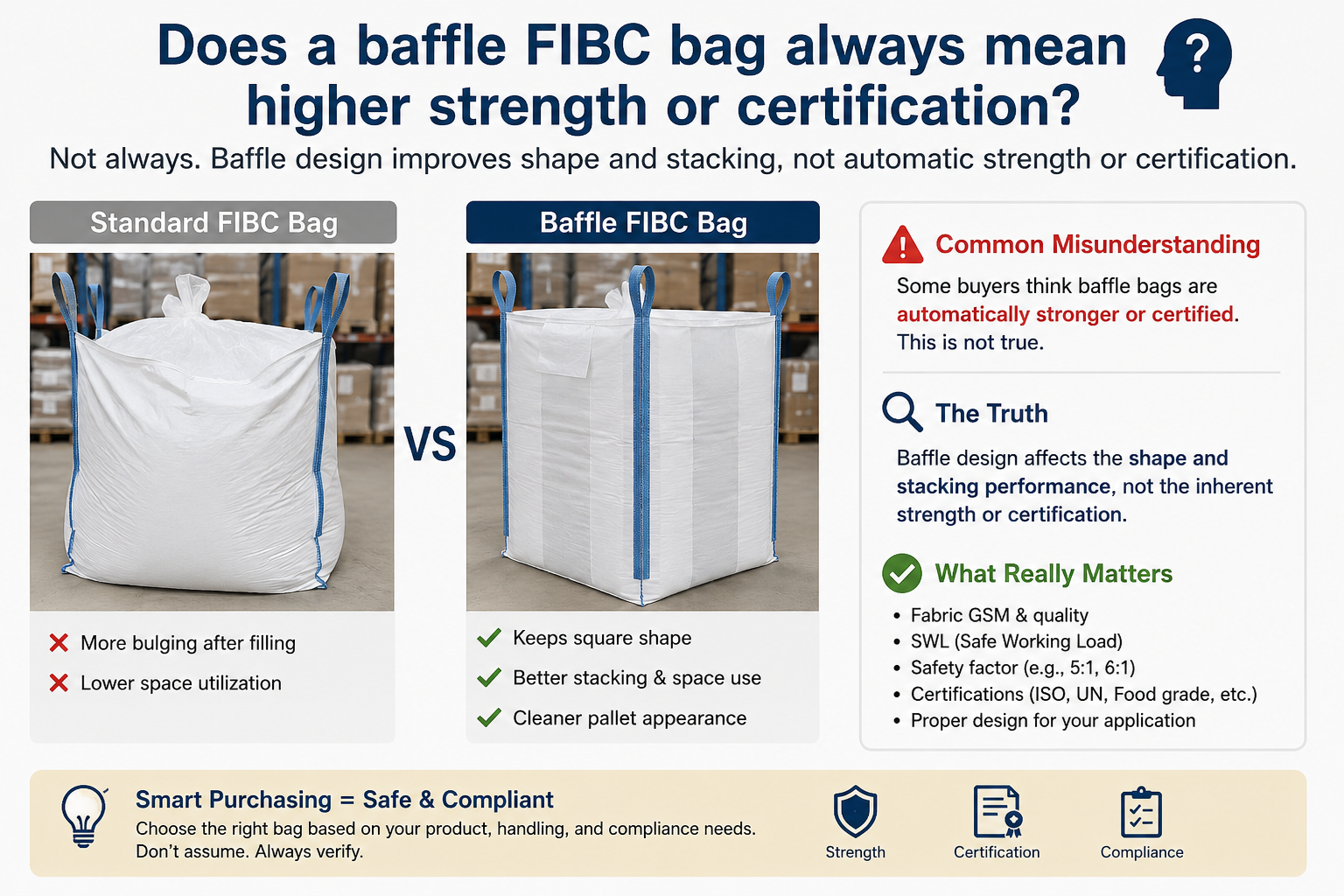
I see some buyers think a baffle bag is automatically stronger. This misunderstanding can lead to unsafe or non-compliant purchasing decisions.
A baffle FIBC bag does not automatically mean higher SWL, food-grade compliance, UN approval, or better safety performance.8 I must specify and verify each requirement separately through design, production control, and needed testing.
Shape control is not the same as load rating
I separate shape control from load capacity. The baffle structure helps the bag reduce side bulging. The SWL depends on fabric strength, sewing strength, loop design, safety factor, and test results.9 A 1000 kg baffle bag is not the same as a 1500 kg baffle bag. The baffle panels alone do not make the bag suitable for heavier loads.
This point is important for purchasing managers because internal teams may see a square bag and assume it is more stable and stronger. I always tell them to check the safe working load, safety factor, and test documents. If the bag is single trip, multiple trip, UN, or food grade, the design and documentation must match that use.
| Requirement | Does baffle structure provide it automatically? | What I need to confirm |
|---|---|---|
| Better shape control | Yes, in many suitable cases | Material flow and filling condition |
| Higher SWL | No | Fabric, loop, sewing, and test standard |
| Food-grade status | No | Raw material control and clean production needs |
| UN approval | No | UN design type, test report, and packing group |
| Anti-static function10 | No | Type B, C, or D requirement |
| UV resistance | No | UV additive level and storage condition |
| Leak control | No | Coating, liner, seam type, and powder property |
Certification must be named from the start
I have seen projects slow down because certification was mentioned too late. A buyer may first ask for a baffle bag for food powder. Later, they say they need food-grade documents. This changes the raw material control, production environment, and document package. The same issue happens with UN dangerous goods bags. UN packaging is not only a printed mark. It is a tested design type with defined structure and use conditions.11
I do not present myself as a laboratory. I work from factory-side experience, production control, and buyer specification discussions. If a buyer needs a specific certificate or test report, I ask them to state it early. Then I can check whether we have a matching design, or whether a new test is needed.
Safety needs clear use conditions
A safe bag is not only a bag made by a good factory. A safe bag must match the actual use. I ask about lifting points, forklift handling, filling temperature, storage time, and stacking height. I also ask whether the bag will be lifted by one loop, two loops, or four loops. Wrong handling can damage even a well-made bag. This is why I try to make the specification practical, not only technical.
How should I compare the cost of a baffle FIBC bag?
I understand why buyers compare unit prices first. But a lower unit price can become expensive if the bag wastes storage and shipping space.
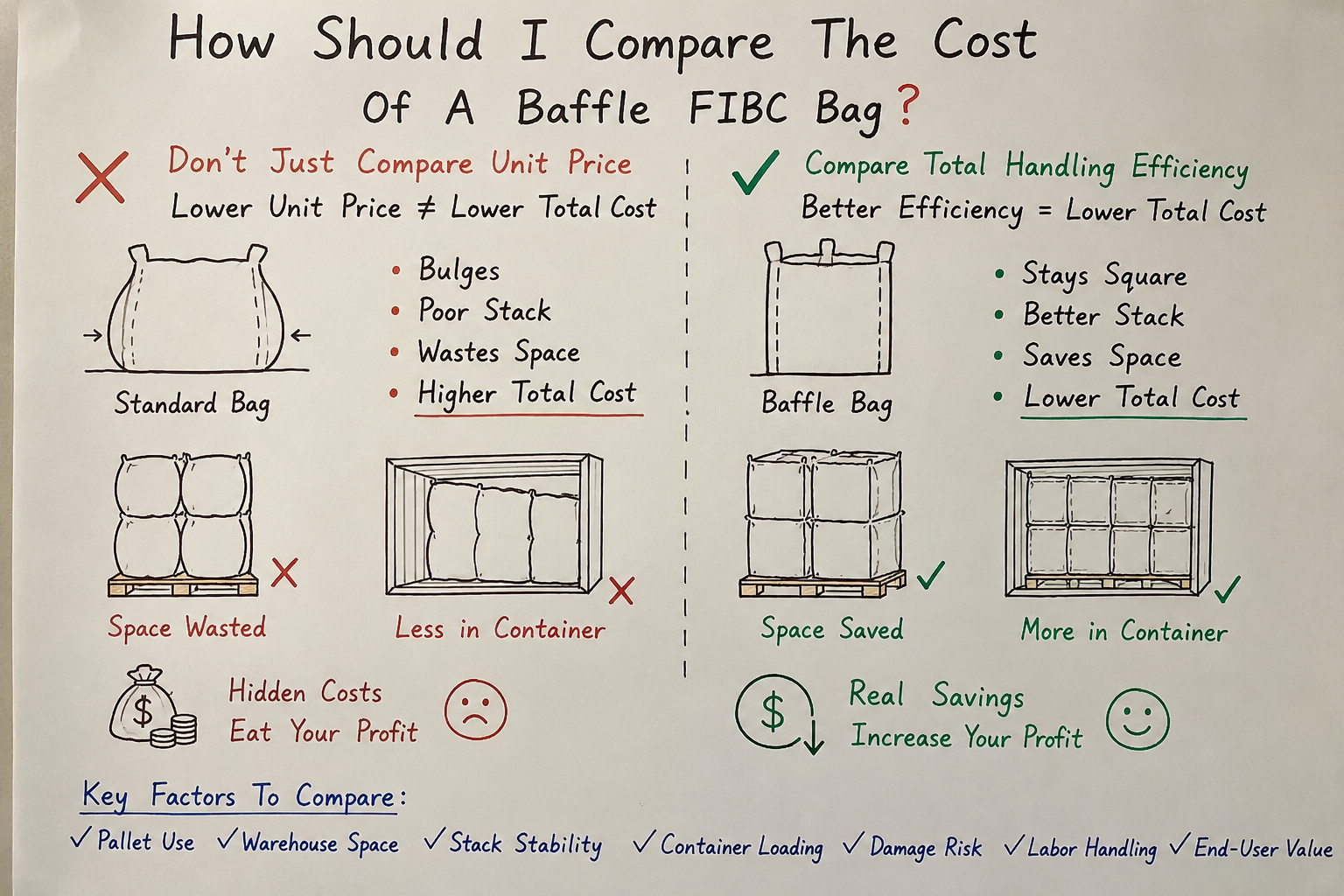
I compare baffle FIBC cost by total handling efficiency, not only unit price. I check pallet use, warehouse space, stack stability, container loading, damage risk, labor handling, and the value the buyer can explain to end users.
I compare the full cost path
A baffle bag usually costs more than a standard FIBC because it needs more material, more sewing work, and more production control. This is easy to see in the quotation. The harder part is the hidden cost. A standard bag may be cheaper per piece, but it may bulge so much that fewer bags fit on a pallet or in a container. It may create unstable stacks. It may require more warehouse space. It may create complaints from distributors or end users.
I do not say baffle bags always save money. I say the buyer should compare the right numbers. If the baffle bag improves container loading, the freight saving may be important.12 If the warehouse space is tight, the storage value may be important. If the customer wants a clean square stack, the sales value may be important.
| Cost item | Standard FIBC | Baffle FIBC |
|---|---|---|
| Unit bag price | Usually lower | Usually higher |
| Shape after filling | More bulging | More controlled |
| Pallet fit | May waste space | Often better when designed well |
| Stack stability | Depends on product and design | Often improved in suitable use |
| Container loading | May lose volume | Can improve loading plan |
| Sampling need | Often simpler | More important |
| Best use case | Basic bulk handling | Space and shape-sensitive handling |
I help distributors explain the value
Many packaging distributors buy baffle bags for end customers. In that case, they need to explain why the price is higher. I usually suggest a simple message. The distributor should not say only “this is a better bag.” They should explain that the bag is designed to control bulging and improve space use. They can show pallet photos, filled bag photos, or container loading data. This makes the value easier to understand.
If the end user only compares unit price, the distributor may lose the order. If the end user compares full handling cost, the baffle bag has a fair chance. I have seen that clear photos and simple loading data are often more convincing than long technical words.
I still avoid over-selling
I do not push baffle bags when they are not needed. If a standard FIBC already stacks well and the buyer does not need better space use, I may suggest staying with the current design. Trust matters in long-term FIBC supply. I would rather help the buyer choose the right bag than sell a more expensive bag that creates no real benefit.
How can I help a buyer customize the right baffle FIBC bag?
I see the best projects start with clear facts. I see the worst projects start with only a target price and a rough photo.
I help a buyer customize the right baffle FIBC bag by checking the product, load, bag size, filling and discharge method, pallet plan, container target, safety needs, and test expectations before production.
My practical custom process
I begin with the material and the current packing problem. Then I move to size, load, fabric, baffle design, top and bottom design, liner needs, printing, and packing method. I try to keep the discussion direct because most buyers are busy. They need clear answers. They do not need empty sales words.
For example, if a buyer packs food powder, I ask about food-grade requirements, liner needs, dust control, and clean production. If a buyer packs minerals, I ask about density, abrasion, moisture, and lifting safety. If a buyer packs resin pellets, I ask about flow, static control, pallet size, and container loading. The same baffle bag name can lead to very different specifications.
| Step | What I do | Buyer benefit |
|---|---|---|
| 1 | I review the material and density | The bag volume matches the real product |
| 2 | I confirm target weight and size | The bag fits pallet and loading needs |
| 3 | I choose top and bottom design | Filling and discharge become smoother |
| 4 | I check baffle structure | Shape control matches product flow |
| 5 | I confirm documents and tests | Compliance risk becomes lower |
| 6 | I support sample production | The buyer can test before full order |
| 7 | I adjust after feedback | The final bulk order becomes safer |
I ask for real operating details
I often ask buyers to share photos or videos of their current filling and handling process. A short video can show more than a long email. I can see the filling spout, the lifting method, the pallet size, and the way the bag sits after filling. I can also see whether the problem comes from the bag or from the handling process.
I also ask how many bags the buyer wants to load in one container. This number may guide the filled dimensions. If the buyer wants better container use, the bag design must match the loading pattern. A baffle bag can help, but only when the size and pallet plan are correct.
I prefer a clear sample target
Before I make samples, I prefer to define what success means. The buyer may want less bulging, better pallet fit, faster discharge, lower leakage, or better appearance. If we do not define the target, the sample test may become unclear. I like simple test points. The buyer can fill the sample, measure the filled size, check the stack, test discharge, and review handling safety. This direct method helps both sides make a better decision.
Conclusion
I use baffle FIBC bags when shape control, space use, and handling efficiency justify the added design and cost.
"Flexible intermediate bulk container - Wikipedia", https://en.wikipedia.org/wiki/Flexible_intermediate_bulk_container. A general reference on flexible intermediate bulk containers describes them as non-rigid industrial containers for dry flowable products, supporting the contextual point that filled FIBCs can deform rather than retain a fixed box shape; it does not directly quantify pallet-space loss for the specific bag design discussed here. Evidence role: general_support; source type: encyclopedia. Supports: The source should describe FIBCs as flexible bulk containers whose shape changes with filling and handling, supporting the statement that non-rigid bags may bulge and affect logistics.. ↩
"Standard Bulk Bags vs Baffle Bags | FlexSack | ABC Polymer", https://flexsack.com/feeling-bulk-bag-baffled/. An industry or standards-oriented description of baffle FIBCs should support that these bags incorporate internal baffles or panels to limit outward bulging and maintain a more rectangular filled shape; the source may be descriptive rather than a controlled performance test. Evidence role: definition; source type: institution. Supports: The source should define baffle FIBCs and explain that internal baffles or panels are used to restrict bulging and maintain a more cubical shape.. ↩
"Baffle Bulk Bags - Your Exporting Friend - MiniBulk", https://www.minibulk.com/blog/baffle-bulk-bags-your-exporting-friend. A technical description of baffle-bag construction should support that internal baffles are commonly made with openings or flow paths so dry bulk material can distribute through the bag while the panels restrain side-wall expansion; this supports the design principle, not the performance of every product in every baffle layout. Evidence role: mechanism; source type: institution. Supports: The source should explain the functional role of baffle-panel openings in permitting product movement while restraining bag expansion.. ↩
"Principles of FIBC Bulk Bag Filling: Design & Handling - Spiroflow", https://www.spiroflow.com/principles-of-fibc-bulk-bag-filling-design-handling/. Bulk-solids handling literature explains that material density, settling, compaction under vibration, and handling loads affect the distribution of stresses in containers, supporting the contextual claim that a filled FIBC’s shape depends on product and operating conditions; it does not prove the exact deformation for this specific baffle bag. Evidence role: mechanism; source type: education. Supports: The source should support that bulk density, compaction, vibration, and handling affect how bulk solids settle and load flexible containers.. ↩
"Material Flow Testing for Bulk Solids: What Operations Managers ...", https://www.erietechnicalsystems.com/blog/material-flow-testing-for-bulk-solids-what-operations-managers-must-know-before-equipment-design. Bulk-material handling references classify granular materials and many dry pellets or powders as easier to discharge when they are free-flowing, supporting the contextual basis for using baffle FIBCs with such products; suitability still depends on the exact product, moisture, particle size, and filling system. Evidence role: expert_consensus; source type: education. Supports: The source should support the distinction between free-flowing granular materials and cohesive materials in bulk handling, providing context for why such products are often suitable for baffle bags.. ↩
"Solve Powder Bridging and Arching Problems in Silo and Hoppers", https://www.matconibc.com/powder-handling-problems-solved-bridging. Research and engineering references on bulk-solids flow identify arching or bridging as a common failure mode for cohesive powders, supporting the claim that poorly flowing products may discharge slowly or leave residue when obstructed by internal features; the source may address hoppers generally rather than baffle FIBCs specifically. Evidence role: mechanism; source type: research. Supports: The source should explain bridging or arching in cohesive bulk solids and how it can obstruct discharge from containers or hoppers.. ↩
"Basics of Soil Bulk Density - Oklahoma State University Extension", https://extension.okstate.edu/fact-sheets/basics-of-soil-bulk-density. A technical definition of bulk density as the mass of a bulk material per unit volume, including interparticle voids, supports the statement that low- and high-density products occupy different volumes at the same target weight; it does not determine the required FIBC specification by itself. Evidence role: definition; source type: education. Supports: The source should define bulk density as mass of bulk material per unit volume, including void spaces, and thereby support the effect on bag volume and target weight.. ↩
"Understanding Safe Working Load (SWL) and Safety Factor (SF) in ...", https://kanplas.com/blogs/fibc/understanding-safe-working-load-swl-and-safety-factor-sf-in-fibc-bags. Standards and regulatory guidance treat FIBC load rating, food-contact suitability, and dangerous-goods approval as separate design, material-control, and testing requirements, supporting the claim that a baffle structure alone does not establish these properties; the source will not assess the compliance of any individual bag without its test documentation. Evidence role: expert_consensus; source type: government. Supports: The source should show that load rating, food-contact compliance, and dangerous-goods approval are separate regulatory or testing requirements rather than inherent properties of a baffle design.. ↩
"ISO 21898 and AS 3668 Bulk Bag Safety Standards | Smart Pack", https://smartpackgroup.com/iso-21898-as-3668-bulk-bag-safety/. FIBC standards describe safe working load and safety factors as properties verified through design and performance testing of the complete container, including body fabric, seams, and lifting components, supporting the statement that baffles alone do not determine load rating; access to the full standard may be needed for detailed test criteria. Evidence role: expert_consensus; source type: institution. Supports: The source should describe how FIBC SWL and safety factor are established through design and testing of the bag body, seams, and lifting components.. ↩
"Types of FIBCs: A B C & D Explained - National Bulk Bag", https://www.nationalbulkbag.com/types-of-fibc-bulk-bags-a-b-c-d-explained/. Electrostatic-safety guidance for FIBCs distinguishes bag types according to their ability to limit charge accumulation or dissipate charge, supporting the statement that anti-static function is a separate design requirement rather than an automatic result of using baffles; the specific safe use depends on the product, atmosphere, and grounding practices. Evidence role: definition; source type: institution. Supports: The source should support that FIBCs are classified by electrostatic-control properties, such as Type A, B, C, and D, and that anti-static behavior requires specific design features.. ↩
"UN Packaging Guide | FoxValley Containers", https://www.foxvalleycontainers.com/copy-of-metal-container-basics. Dangerous-goods regulations describe UN packaging marks as indicating a packaging design type that has met specified performance tests and is subject to defined use conditions, supporting the statement that the mark is not merely decorative; the exact requirements vary by jurisdiction and packing group. Evidence role: definition; source type: government. Supports: The source should state that UN dangerous-goods packaging marks correspond to tested packaging designs and conditions of use.. ↩
"[PDF] The Impact of Mega-Ships - International Transport Forum", https://www.itf-oecd.org/sites/default/files/docs/15cspa_mega-ships.pdf. Logistics references explain that freight efficiency is affected by both weight and volume utilization of transport equipment, supporting the contextual claim that better container loading can influence shipping cost; the source would not prove that a given baffle FIBC design will save freight without shipment-specific loading data. Evidence role: general_support; source type: institution. Supports: The source should support that freight costs and shipping efficiency are affected by container utilization, volume, weight limits, and loading efficiency.. ↩